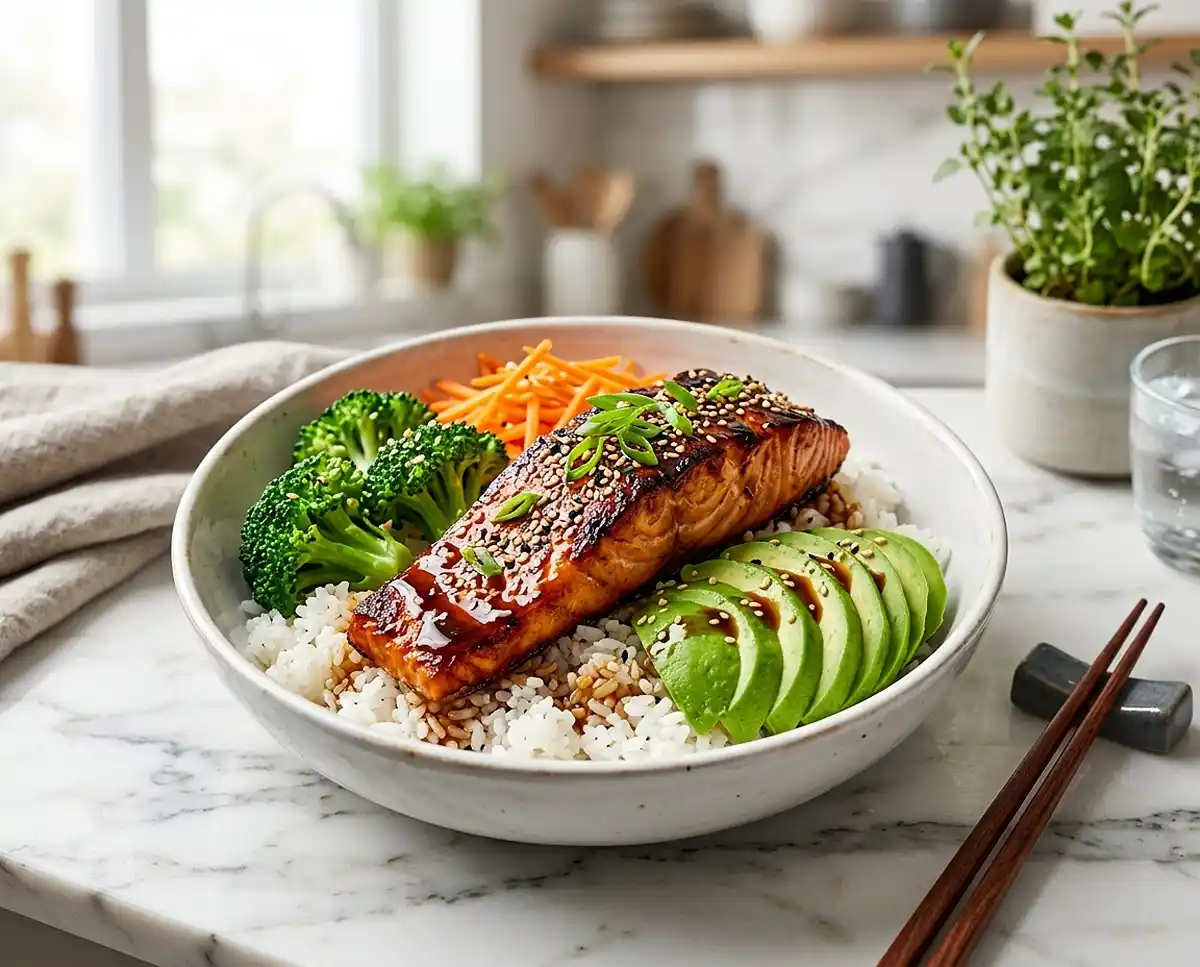
Teriyaki Salmon Rice Bowls
These Teriyaki Salmon Rice Bowls are better than takeout and ready in 30 minutes. Crispy salmon, glossy homemade teriyaki sauce, and fresh toppings — save this one.
I’ve made Teriyaki Salmon Rice Bowls more times than I can count — and the detail that changed everything for me was patting the salmon completely dry before it hits the pan. Sounds minor. It’s not. Wet salmon steams instead of sears, and you lose that golden, crispy crust that makes the whole bowl.
These salmon rice bowls have that sweet-savory, takeout-at-home kind of magic people end up craving again before the leftovers are even gone. If this one’s already calling your name, don’t miss more healthy bowl meals for dinner.
Table of Contents
Why You’ll Love These Teriyaki Salmon Rice Bowls
The homemade teriyaki sauce takes about 5 minutes and tastes nothing like the bottled stuff — it’s glossy, sticky, and has real ginger and garlic in it. And it doubles as a drizzle over everything in the bowl, not just the salmon.
You get a genuinely balanced meal in one bowl: protein, healthy fats from the avocado, fiber from the broccoli and carrots, and complex carbs from the rice. No side dishes needed. No complicated techniques either.
It’s fast enough for a Tuesday night and good-looking enough to photograph. Honestly, the bar for a healthy salmon bowl this satisfying is higher than this recipe makes it feel.
What Ingredients Do You Need for Teriyaki Salmon Rice Bowls?
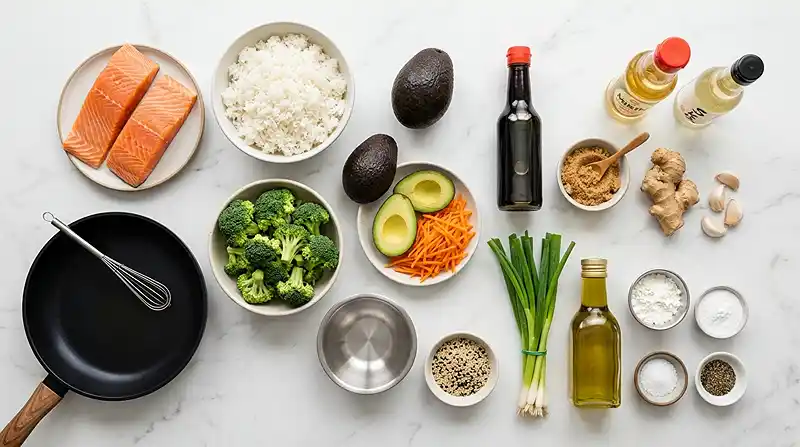
| Ingredient Group | Ingredient | Amount | Notes |
|---|---|---|---|
| Salmon | Salmon fillets (about 6 oz each) | 2 | Skin-on preferred |
| Salmon | Olive oil | 1 tablespoon | |
| Salmon | Salt and black pepper | To taste | Season both sides |
| Bowl Base | Cooked white or brown rice | 1 cup | Divided between 2 bowls |
| Vegetables | Broccoli florets, steamed or roasted | 1 cup | |
| Vegetables | Avocado, sliced | 1/2 | Ripe but firm |
| Vegetables | Shredded carrots | 1/4 cup | |
| Garnish | Sesame seeds | 1 tablespoon | |
| Garnish | Sliced green onions | To taste | |
| Teriyaki Sauce | Soy sauce | 1/4 cup | Low-sodium works fine |
| Teriyaki Sauce | Mirin | 2 tablespoons | Sweet rice wine |
| Teriyaki Sauce | Sake (optional) | 1 tablespoon | Skip or sub water |
| Teriyaki Sauce | Brown sugar | 1 tablespoon | Packed |
| Teriyaki Sauce | Fresh ginger, grated | 1 teaspoon | Not ground ginger |
| Teriyaki Sauce | Garlic, minced | 1 clove | |
| Teriyaki Sauce | Cornstarch mixed with water (slurry) | 1 tsp + 1 tbsp | Mix before adding |
The mirin is what gives homemade teriyaki sauce its characteristic glossy sheen and subtle sweetness — don’t skip it. You’ll find it in the Asian foods aisle at most grocery stores, and a bottle lasts for months in the fridge.
For the salmon, skin-on fillets hold together better in the pan and the skin crisps up beautifully. But if skinless is all you have, it still works — just handle them a little more gently when flipping. Brown rice adds a nutty, chewy quality to the bowl that makes it feel more like a satisfying healthy dinner bowl than a quick weeknight meal.
How to Make Teriyaki Salmon Rice Bowls Step by Step
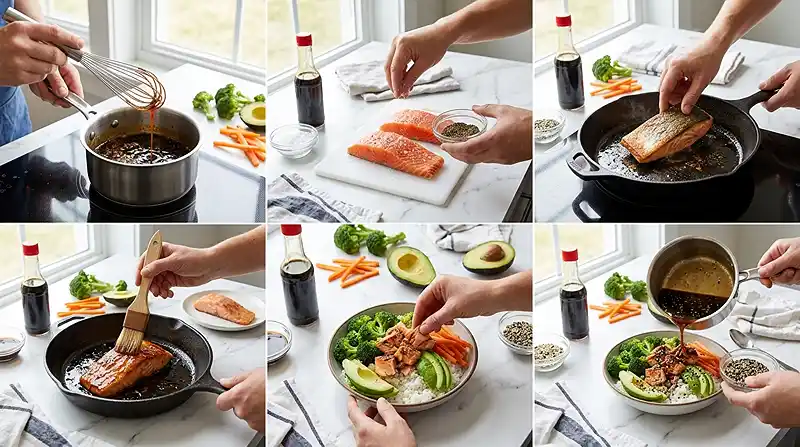
Make the Teriyaki Sauce
- In a small saucepan, combine soy sauce, mirin, sake (if using), brown sugar, grated ginger, and minced garlic.
- Bring to a simmer over medium heat, stirring until the sugar dissolves.
- Stir in the cornstarch slurry and cook, stirring constantly, until the sauce thickens to your desired consistency.
- Remove from heat and set aside.
Pro Tip: The key to a glossy, restaurant-quality teriyaki sauce is adding the cornstarch slurry only after the sauce is already simmering — adding it to a cold liquid causes lumps that don’t cook out.
Cook the Salmon
- Pat the salmon fillets dry with a paper towel.
- Season both sides with salt and black pepper.
- Heat olive oil in a non-stick skillet over medium-high heat.
- Place salmon skin-side down (if present) and cook for 4-5 minutes, until the skin is crispy.
- Flip the salmon and cook for another 3-5 minutes, until cooked through and flakes easily with a fork.
- During the last minute of cooking, brush the salmon with 1-2 tablespoons of the prepared teriyaki sauce.
Pro Tip: For best results, don’t move the salmon once it hits the pan — let it cook undisturbed for the full 4-5 minutes skin-side down so the crust develops properly before you flip.
Assemble and Serve
- Divide the cooked rice between two bowls.
- Arrange the cooked salmon over the rice.
- Add steamed or roasted broccoli, sliced avocado, and shredded carrots to each bowl.
- Drizzle additional teriyaki sauce over the salmon and vegetables.
- Garnish with sesame seeds and sliced green onions.
- Serve immediately.
Pro Tip: Warm your rice and have all the bowl components ready before the salmon goes in the pan — salmon waits for no one, and cold toppings around hot fish is a sad bowl.
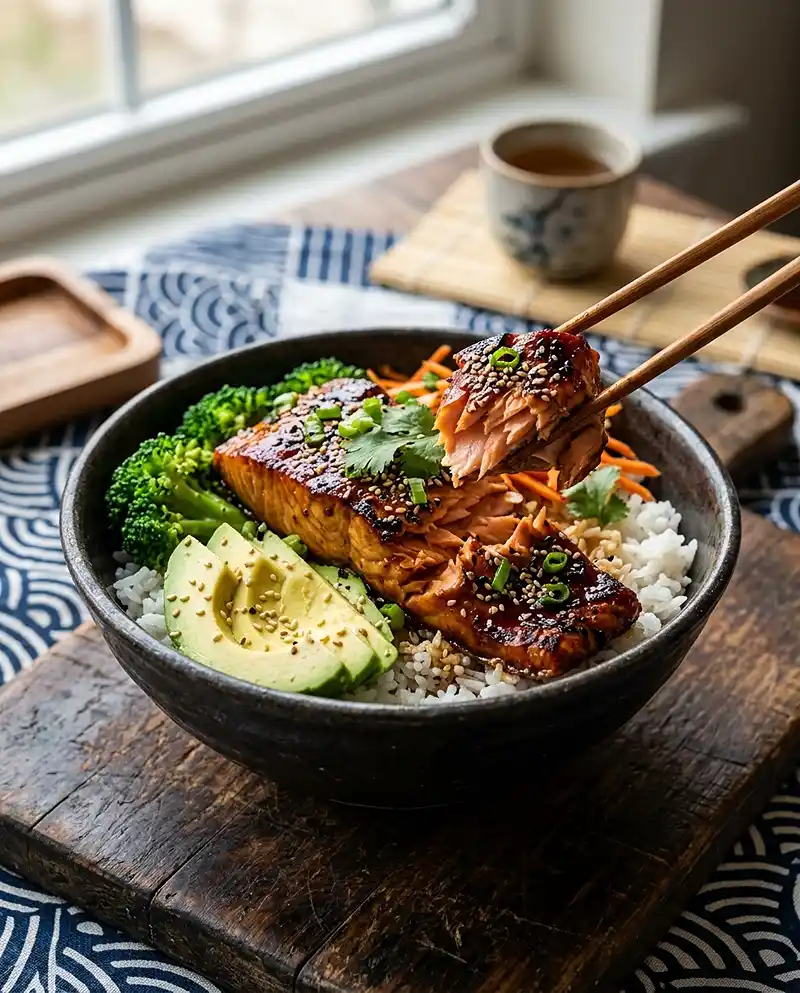
Expert Tips for Perfect Teriyaki Salmon Rice Bowls
Pro Tips for Success
The key to crispy salmon is a completely dry surface before searing. Press paper towels firmly on all sides and let the fillets sit for a minute after drying. Any surface moisture turns to steam in the pan, and steam is the enemy of a golden crust.
Teriyaki Salmon Rice Bowls work best when the pan is fully preheated before the fish goes in. Add the olive oil and wait until it shimmers — about 30 seconds over medium-high heat. A cold pan means the salmon sticks, and you’ll tear the fillet trying to flip it.
The most common mistake is overcooking the salmon — instead, pull it off the heat as soon as it flakes easily at the thickest part. Salmon carries over heat after you remove it from the pan. If it flakes perfectly in the skillet, it’ll be overdone in the bowl.
For best results, roast the broccoli instead of steaming it. Toss florets with a little olive oil and roast at 400°F for 18-20 minutes until the edges char slightly. That caramelized, slightly crispy texture pairs far better with the savory-sweet sauce than steamed broccoli does.
Make a double batch of the teriyaki sauce and keep it in the fridge. It stores for up to two weeks in a sealed jar and works on chicken, tofu, or as a stir-fry sauce. Having it ready cuts your prep time in half next time.
Delicious Variations
Low-Carb Version: Swap the rice for cauliflower rice, either homemade or store-bought frozen. The teriyaki sauce and salmon are naturally low in carbs, so this swap makes the whole bowl keto-friendly without changing anything else about the recipe.
Dairy-Free Version: Good news — this recipe is already completely dairy-free as written. Every component, including the homemade teriyaki sauce, contains no dairy. Just check your soy sauce label if you’re also avoiding gluten, as some brands contain wheat.
Meal Prep Version: Cook a larger batch of salmon and sauce at the start of the week and store them separately in the fridge. Assemble individual bowls each day with fresh rice and toppings. This is one of those easy salmon bowl recipes that actually holds up well across 3-4 days without getting soggy if you keep the sauce on the side.
Troubleshooting Common Problems
Problem: Salmon stuck to the pan and fell apart when flipping.
Solution: The pan wasn’t hot enough, or the salmon needed more time before flipping. When the salmon is ready, it releases naturally from the pan — if it’s sticking, give it another 60 seconds before trying again.
Problem: Teriyaki sauce is too thin and watery.
Solution: It needs more time to reduce. Return it to low heat and stir for another 2-3 minutes, or add a small additional cornstarch slurry (half a teaspoon of cornstarch mixed with a teaspoon of water) and stir until thickened.
Problem: Sauce tastes too salty.
Solution: Switch to low-sodium soy sauce next time. To balance an already-made batch, add an extra half teaspoon of brown sugar and a squeeze of fresh lemon or lime juice — the sweetness and acid soften the salt.
How to Store and Reheat Teriyaki Salmon Rice Bowls
| Storage Method | Duration | Best Practice |
|---|---|---|
| Room Temperature | Up to 2 hours | Keep components separate; don’t leave assembled bowls out |
| Refrigerator | Up to 3 days | Store salmon, rice, vegetables, and sauce in separate airtight containers |
| Freezer | Up to 1 month (salmon only) | Freeze cooked salmon and sauce separately; do not freeze avocado or assembled bowls |
To reheat salmon, skip the microwave if you can — it turns the texture rubbery fast. A dry non-stick skillet over medium-low heat for 2-3 minutes per side keeps it tender and warm without overcooking. The skin won’t be crispy again, but the flesh stays flaky rather than dry.
Leftover salmon is genuinely excellent flaked over a green salad with the extra teriyaki sauce as a dressing, or stirred into fried rice with the leftover carrots and broccoli. It’s also great in a wrap with shredded cabbage and a drizzle of sauce — no reheating required. For more ideas like this, check out these healthy dinner bowl recipes to keep the rotation going.
FAQs About Teriyaki Salmon Rice Bowls
Can I use store-bought teriyaki sauce instead of homemade?
Yes, store-bought teriyaki sauce works in a pinch. Use about 3-4 tablespoons for glazing and drizzling. That said, the homemade version in this recipe takes 5 minutes and the flavor difference — especially with the fresh ginger and garlic — is significant enough that it’s worth making at least once before defaulting to a bottle.
How do I know when the salmon is cooked through?
The salmon is done when it flakes easily when pressed with a fork at the thickest part and the flesh has turned from translucent to opaque throughout. An internal temperature of 125-130°F gives a moist, just-cooked center; 145°F is the FDA recommendation for fully cooked fish. The 3-5 minutes per side in this recipe lands in that range for a standard 6 oz fillet.
Can I make these salmon rice bowls ahead of time for meal prep?
Yes, with a few adjustments. Cook the salmon, rice, and sauce ahead and store them separately in airtight containers in the fridge for up to 3 days. Slice the avocado fresh each day — it browns quickly once cut. Assemble each bowl when you’re ready to eat and add the sauce just before serving.
What can I substitute for mirin in the teriyaki sauce?
If you don’t have mirin, use 2 tablespoons of dry white wine or rice vinegar with an extra half teaspoon of brown sugar to replicate the sweet, slightly acidic balance. The sauce won’t have quite the same glossy finish, but the flavor is close. Avoid substituting plain water — it dilutes the sauce without adding anything back.
Is this recipe gluten-free?
Not as written, because standard soy sauce contains wheat. To make it gluten-free, substitute tamari (a Japanese soy sauce made without wheat) or coconut aminos at a 1:1 ratio. Everything else in the recipe — salmon, rice, vegetables, mirin, and the other sauce ingredients — is naturally gluten-free.
Go Make These Tonight — Seriously
These bowls have become a weekly staple in my house and I honestly can’t see that changing. The homemade teriyaki sauce alone is worth learning, and once you nail the crispy salmon technique, you’ll want to put it on everything.
If you make them, drop a comment and tell me what toppings you added — I’d love to know if you went team broccoli or swapped in something else. And save this to Pinterest so it’s easy to find when the weeknight dinner panic hits.
For more bowl dinners you’ll actually make on repeat, the honey lime chicken burrito bowls and these Mediterranean chicken quinoa bowls are both seriously good.
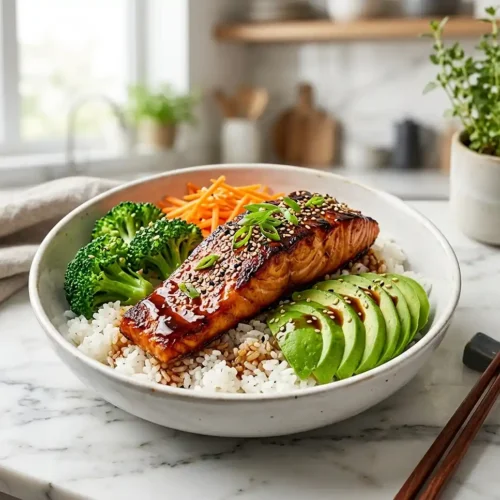
Teriyaki Salmon Rice Bowls with glossy homemade sauce, crispy pan-seared salmon, creamy avocado, and fresh veggies — a healthy, stunning bowl ready in 30 minutes. Save this for your next weeknight dinner!
Teriyaki Salmon Rice Bowls with Homemade Sauce
Equipment
- Small saucepan
- Non-stick skillet
- Paper towels
- Pastry brush
- Mixing bowl
- Cutting board
- Sharp knife
Ingredients
Salmon
- 2 salmon fillets (about 6 oz each) Skin-on preferred
- 1 tablespoon olive oil
- salt and black pepper To taste, season both sides
Bowl Base
- 1 cup cooked white or brown rice Divided between 2 bowls
Vegetables
- 1 cup broccoli florets, steamed or roasted
- ½ avocado, sliced Ripe but firm
- ¼ cup shredded carrots
Garnish
- 1 tablespoon sesame seeds
- sliced green onions To taste
Teriyaki Sauce
- ¼ cup soy sauce Low-sodium works fine
- 2 tablespoons mirin Sweet rice wine
- 1 tablespoon sake (optional) Skip or sub water
- 1 tablespoon brown sugar Packed
- 1 teaspoon fresh ginger, grated Not ground ginger
- 1 clove garlic, minced
- 1 tsp + 1 tbsp cornstarch mixed with water (slurry) Mix together before adding
Instructions
- In a small saucepan, combine soy sauce, mirin, sake (if using), brown sugar, grated ginger, and minced garlic. Bring to a simmer over medium heat, stirring until the sugar dissolves.
- Stir in the cornstarch slurry and cook, stirring constantly, until the sauce thickens to your desired consistency. Remove from heat and set aside.
- Pat the salmon fillets dry with a paper towel. Season both sides with salt and black pepper.
- Heat olive oil in a non-stick skillet over medium-high heat. Place salmon skin-side down (if present) and cook for 4-5 minutes, until the skin is crispy.
- Flip the salmon and cook for another 3-5 minutes, until cooked through and the fish flakes easily with a fork.
- During the last minute of cooking, brush the salmon with 1-2 tablespoons of the prepared teriyaki sauce.
- Divide the cooked rice between two bowls. Arrange the cooked salmon over the rice.
- Add steamed or roasted broccoli, sliced avocado, and shredded carrots to each bowl.
- Drizzle additional teriyaki sauce over the salmon and vegetables. Garnish with sesame seeds and sliced green onions. Serve immediately.