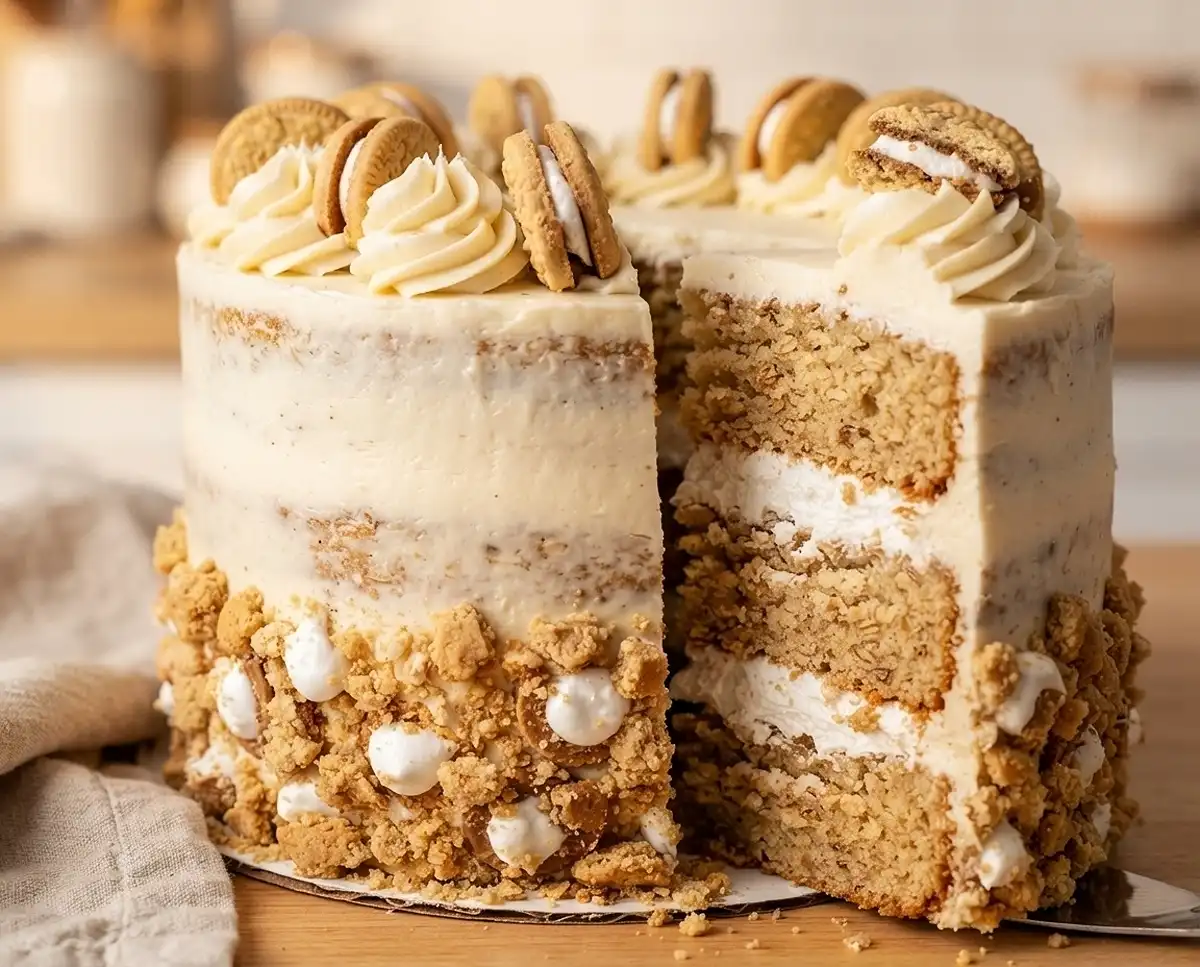
Oatmeal Creme Pie Cake
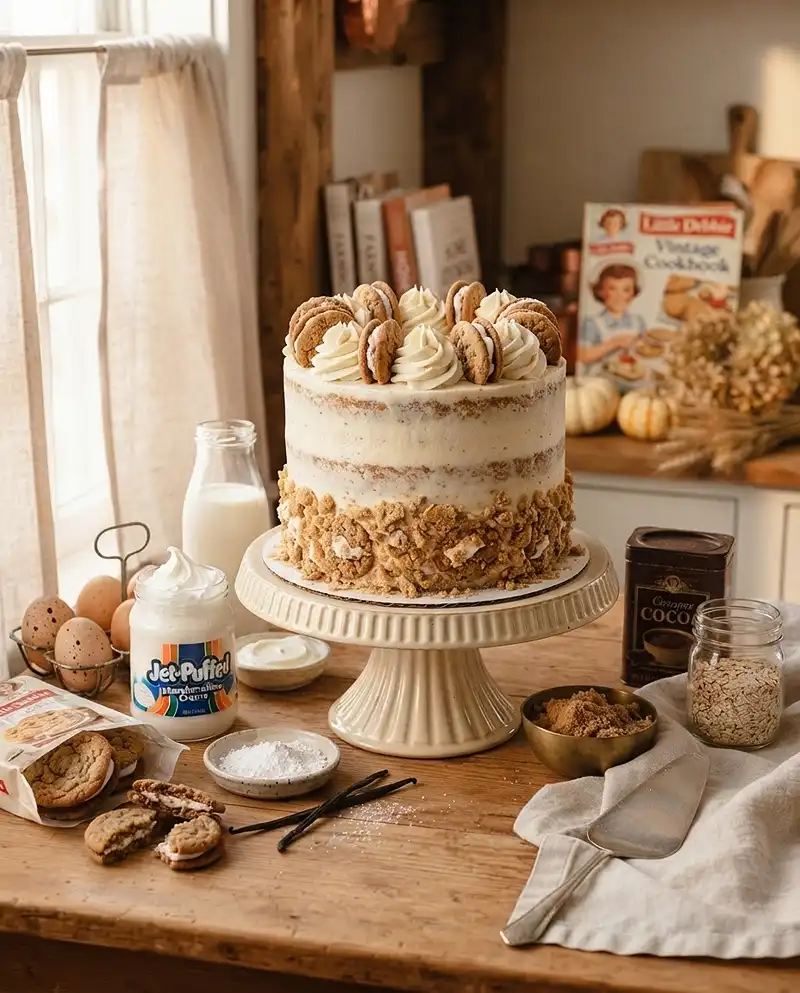
Oatmeal creme pie cake is a layer cake built around the nostalgic flavor of Little Debbie oatmeal creme pies — a brown sugar oatmeal cake stacked with fluffy marshmallow creme filling, covered in vanilla buttercream, and finished with actual Oatmeal Creme Pies pressed right into the frosting.
It’s the kind of showstopper that reads as impressive but comes together with straightforward techniques. The oat-speckled layers are warmly spiced with cinnamon, and that marshmallow filling delivers the exact creamy, pillowy hit you remember from the original cookie.
Table of Contents
Why You’ll Love This Oatmeal Creme Pie Cake
- Captures the nostalgic flavor of oatmeal creme pies in a stunning layer cake
- The marshmallow creme filling is light, sweet, and stabilized by a buttercream dam — no messy blowouts
- Brown sugar and cinnamon give the cake layers real depth, not just sweetness
- The semi-naked finish with crumbled cookie garnish is a crowd-pleasing look that’s easier than it appears
- Works as three 6-inch layers or two 8-inch layers — flexible for what you have on hand
Oatmeal Creme Pie Cake with Marshmallow Filling
Equipment
- Three 6-inch cake pans or two 8-inch cake pans
- Baking spray
- Wax paper or parchment paper
- Food processor
- Medium Mixing Bowl
- Whisk
- Stand mixer or hand mixer
- Paddle attachment
- Rubber spatula
- Wire rack
- Serrated knife or cake leveler
- Cake turntable
- Piping bags
- Icing smoother
- Wilton Tip 4B
- Plastic wrap
- Cake carrier
- oven
- Toothpick
Ingredients
Brown Sugar Oatmeal Cake
- ¾ cup old-fashioned rolled oats 71 g, ground into small pieces in a food processor; quick oats work too
- 1 ¾ cups cake flour 186 g, sifted
- 1 ½ teaspoons baking powder
- ¼ teaspoon baking soda
- 1 teaspoon ground cinnamon essential for the oatmeal creme pie flavor profile
- ½ teaspoon salt balances sweetness
- ½ cup unsalted butter 113 g, room temperature
- 2 tablespoons vegetable oil 30 ml, adds moisture and tenderness
- ½ cup granulated sugar 100 g
- ½ cup packed brown sugar 100 g, light or dark; key for molasses depth and cookie-like flavor
- 2 large eggs room temperature
- ¼ cup sour cream 60 g, room temperature
- 2 teaspoons pure vanilla extract
- 1 cup whole milk 240 ml, room temperature
Marshmallow Creme Filling
- ½ cup unsalted butter 113 g, room temperature
- 1 cup powdered sugar 105 g
- 7 ounces Jet-Puffed Marshmallow Creme 198 g; jarred kind recommended for smooth texture and stability
- 1 teaspoon pure vanilla extract
- 1 pinch salt or to taste
Vanilla Buttercream Frosting
- 1 cup unsalted butter 226 g, room temperature
- 3 ½ cups powdered sugar 420 g, sifted if possible and added one cup at a time
- 2 teaspoons pure vanilla extract
- 2 tablespoons whole milk room temperature, adjusts frosting consistency
- 1 pinch salt or to taste
Garnish
- 2 cookies Oatmeal Creme Pies quartered, placed between piped swirls on top
- 2 cookies Oatmeal Creme Pies crumbled, pressed onto the bottom third of the frosted cake
Instructions
- Preheat the oven to 350°F. Prepare three 6-inch cake pans or two 8-inch cake pans by spraying the sides with baking spray and fitting a wax paper or parchment paper circle into the bottom of each pan. Alternatively, grease and lightly flour the pans.
- Pulse the old-fashioned rolled oats in a food processor into small pieces. Do not process them into a fine powder; small irregular pieces add texture without making the cake chewy.
- Transfer the ground oats to a medium bowl. Add the cake flour, baking powder, baking soda, cinnamon, and salt. Whisk to combine and set aside.
- In the bowl of a stand mixer, or using a handheld mixer, cream the butter on high speed until creamy, about 2 minutes.
- Add the vegetable oil, granulated sugar, and brown sugar. Mix on medium-high speed for another 2 minutes, then scrape down the bowl and paddle.
- Turn the mixer to low speed and mix in the eggs one at a time.
- Add the sour cream and vanilla extract, then turn the mixer to high speed and beat for 1 minute.
- With the mixer on low speed, add the dry ingredients and mix until just combined.
- Pour in the milk in a slow stream and mix until just incorporated. Scrape down the sides and bottom of the bowl and stir a few times by hand to make sure there are no large lumps. The batter will be thick.
- Divide the batter evenly between the prepared pans and bake for 30 to 35 minutes, until the cakes spring back to the touch and a toothpick inserted in the center comes out clean.
- Let the cakes cool in the pans for 5 minutes, then turn them out onto a wire rack to cool completely before frosting.
- Make the marshmallow creme filling. In the bowl of a stand mixer fitted with the paddle attachment, or using a hand mixer, whip the butter on high speed until smooth and creamy, about 5 minutes.
- Turn the mixer to low speed and add the powdered sugar. Mix until fully combined, about 2 minutes.
- Add the Jet-Puffed Marshmallow Creme, vanilla extract, and salt. Continue mixing on low speed until combined and uniform, 1 to 2 minutes. Set aside.
- Make the vanilla buttercream. With a hand mixer or the paddle attachment on a stand mixer, cream the butter on medium-high speed until creamy, light, and almost white in color, about 7 minutes.
- Turn the mixer to low speed and add the sifted powdered sugar 1 cup at a time, scraping down the bowl after each addition and making sure each cup is fully incorporated before adding the next.
- Add the vanilla extract, milk, and salt. Mix on low speed for 1 to 2 minutes, until fully incorporated and smooth.
- Once the cake layers are completely cooled, level and torte each layer to your desired height.
- Add about 1 cup of vanilla buttercream to a piping bag and snip off a 1/2-inch opening.
- Place the first cake layer on a turntable. Pipe a circle of vanilla buttercream around the edge of the layer to create a dam, then fill the center with half of the marshmallow creme filling.
- Place the next cake layer on top and repeat by piping another buttercream dam around the edge, then filling the center with the remaining marshmallow creme filling.
- Place the final layer on top, upside down so the flat bottom of the cake layer becomes the top of the finished cake.
- Crumb coat the entire cake with vanilla buttercream and refrigerate for at least 20 minutes to let everything set.
- Use an icing smoother to create a semi-naked frosting finish. Press the crumbled Oatmeal Creme Pies onto the bottom third of the cake.
- Refrigerate the cake for about 10 minutes to let the frosting firm up.
- Add the remaining vanilla buttercream to a piping bag fitted with a Wilton Tip 4B. Pipe swirls around the top edge of the cake, leaving about 1/4 inch between each swirl.
- Place a quartered section of Oatmeal Creme Pie between each swirl to finish. Serve at room temperature for the best texture.
Notes
What Ingredients Do You Need for Oatmeal Creme Pie Cake?
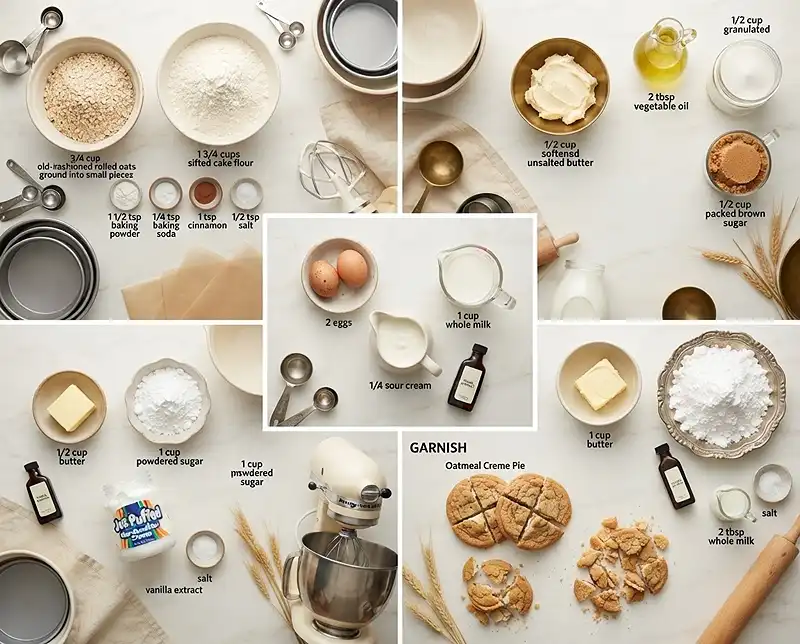
| Ingredient Group | Ingredient | Exact Amount | Purpose or Note |
|---|---|---|---|
| Brown Sugar Oatmeal Cake | Old-fashioned rolled oats (ground) | 3/4 cup (71g) | Pulse in food processor; quick oats work too |
| Brown Sugar Oatmeal Cake | Cake flour, sifted | 1 3/4 cups (186g) | DIY recipe available in notes |
| Brown Sugar Oatmeal Cake | Baking powder | 1 1/2 tsp | Leavening |
| Brown Sugar Oatmeal Cake | Baking soda | 1/4 tsp | Leavening |
| Brown Sugar Oatmeal Cake | Ground cinnamon | 1 tsp | Warm spice — essential to the flavor profile |
| Brown Sugar Oatmeal Cake | Salt | 1/2 tsp | Balances sweetness |
| Brown Sugar Oatmeal Cake | Unsalted butter, room temperature | 1/2 cup (113g) | Creamed for structure |
| Brown Sugar Oatmeal Cake | Vegetable oil | 2 Tbsp (30ml) | Adds moisture and tenderness |
| Brown Sugar Oatmeal Cake | Granulated sugar | 1/2 cup (100g) | Sweetness and structure |
| Brown Sugar Oatmeal Cake | Packed brown sugar (light or dark) | 1/2 cup (100g) | Molasses depth, key to the cookie flavor |
| Brown Sugar Oatmeal Cake | Large eggs, room temperature | 2 | Structure and richness |
| Brown Sugar Oatmeal Cake | Sour cream, room temperature | 1/4 cup (60g) | Moisture and slight tang |
| Brown Sugar Oatmeal Cake | Pure vanilla extract | 2 tsp | Flavor depth |
| Brown Sugar Oatmeal Cake | Whole milk, room temperature | 1 cup (240ml) | Thins batter to the right consistency |
| Marshmallow Creme Filling | Unsalted butter, room temperature | 1/2 cup (113g) | Base of the filling |
| Marshmallow Creme Filling | Powdered sugar | 1 cup (105g) | Sweetness and structure |
| Marshmallow Creme Filling | Jet-Puffed Marshmallow Creme | 7 oz (198g) | Signature fluffy texture |
| Marshmallow Creme Filling | Pure vanilla extract | 1 tsp | Flavor |
| Marshmallow Creme Filling | Salt | Pinch, or to taste | Balances sweetness |
| Vanilla Buttercream Frosting | Unsalted butter, room temperature | 1 cup (226g) | Creamed until almost white |
| Vanilla Buttercream Frosting | Powdered sugar | 3 1/2 cups (420g) | Added one cup at a time |
| Vanilla Buttercream Frosting | Pure vanilla extract | 2 tsp | Flavor |
| Vanilla Buttercream Frosting | Whole milk, room temperature | 2 Tbsp | Adjusts consistency |
| Vanilla Buttercream Frosting | Salt | Pinch, or to taste | Balances sweetness |
| Garnish | Oatmeal Creme Pies, quartered | 2 cookies | Placed between piped swirls on top |
| Garnish | Oatmeal Creme Pies, crumbled | 2 cookies | Pressed onto the bottom third of frosted cake |
The brown sugar is the heart of this oatmeal creme pie cake — it gives the layers that molasses-tinged warmth that instantly reads as the original cookie. Cake flour keeps the crumb tender rather than dense, and the ground oats add gentle texture without turning the cake chewy.
Jet-Puffed Marshmallow Creme (the jarred kind, not homemade) is specifically called for here because it whips into the filling smoothly and holds its shape between layers. Room temperature dairy and eggs throughout — butter, milk, sour cream, eggs — matter more than they might seem; cold ingredients prevent proper emulsification and can lead to a curdled batter.
How to Make Oatmeal Creme Pie Cake Step by Step
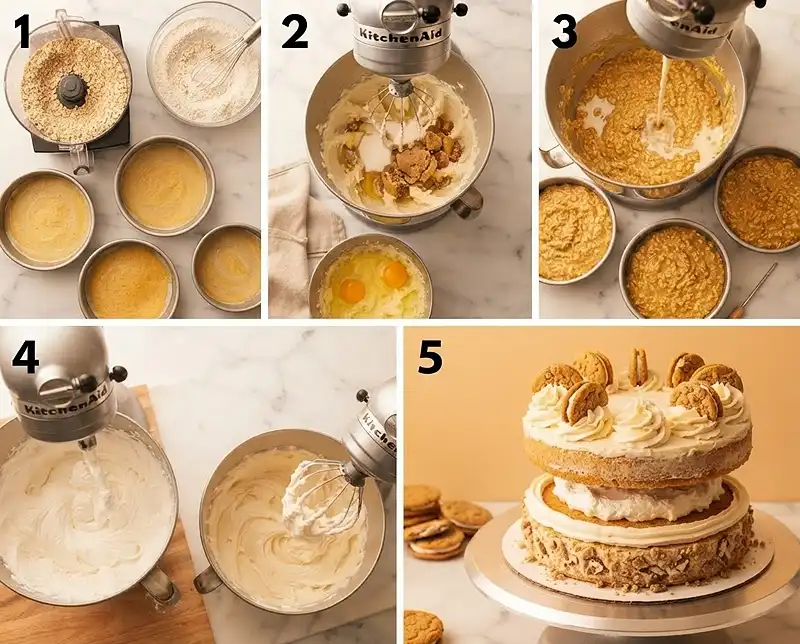
Make the Brown Sugar Oatmeal Cake
- Preheat the oven to 350°F. Prepare three 6-inch cake pans or two 8-inch cake pans by spraying the sides with baking spray and fitting a wax or parchment paper circle to the bottom of each pan. Alternatively, grease and lightly flour the pans.
- Using a food processor, pulse the old-fashioned rolled oats into small pieces. Place them into a medium bowl. Add the cake flour, baking powder, baking soda, cinnamon, and salt. Whisk to combine and set aside. Pro Tip: Don’t over-process the oats into powder — you want small irregular pieces that add texture, not a fine flour.
- In the bowl of a stand mixer (a handheld mixer works fine too), cream the butter on high speed until creamy, about 2 minutes. Add the vegetable oil, granulated sugar, and brown sugar and continue mixing on medium-high for another 2 minutes. Scrape down the bowl and paddle.
- Turn the mixer to low speed and mix in the eggs one at a time. Add the sour cream and vanilla, then turn the mixer to high speed and beat for 1 minute.
- With the mixer on low speed, add the dry ingredients and mix until just combined, then pour in the milk in a slow stream and mix until just incorporated. Scrape down the sides and bottom of the bowl and give it a few stirs by hand to make sure there are no large lumps. The batter will be thick.
- Divide the batter evenly between the prepared pans and bake for 30–35 minutes. They’re done when they spring back to the touch and a toothpick inserted in the center comes out clean. Let the cakes cool in the pans for 5 minutes, then turn them out onto a wire rack to cool completely before frosting. Pro Tip: Rushing this step is one of the most common causes of melted, sliding frosting — the layers must be fully at room temperature before you assemble.
Make the Marshmallow Creme Filling
- In the bowl of a stand mixer with the paddle attachment, or using a hand mixer, whip the butter on high speed until smooth and creamy, about 5 minutes.
- Turn the mixer to low speed and add the powdered sugar. Mix until fully combined, about 2 minutes.
- Add the Jet-Puffed Marshmallow Creme, vanilla, and salt. Continue to mix on low speed until combined and uniform, 1–2 minutes. Set aside.
Make the Vanilla Buttercream Frosting
- With a hand mixer or paddle attachment on your stand mixer, cream the butter on medium-high until it’s creamy and light — almost white — in color, about 7 minutes.
- Turn the mixer to low speed and add the sifted powdered sugar one cup at a time, scraping down after each addition and making sure each cup is fully incorporated before adding the next.
- Add the vanilla, milk, and salt and mix on low for 1–2 minutes until fully incorporated. Pro Tip: Sifting the powdered sugar before adding it prevents lumps in the buttercream — skip this and you may end up with a gritty frosting that’s hard to smooth out.
Assemble the Cake
- Once the cake layers have cooled completely, level and torte each layer to your desired height.
- Add about 1 cup of vanilla buttercream to a piping bag and snip off a 1/2-inch opening. Place the first cake layer on a turntable and pipe a circle of vanilla buttercream around the edge of the layer to create a dam. Fill the center with half of the marshmallow creme filling.
- Place the next cake layer on top and repeat: pipe the buttercream dam around the edge, then fill the center with the remaining marshmallow creme filling.
- Place the final layer on top, upside down so the bottom of the cake layer becomes the top of the finished cake. Crumb coat the entire cake with vanilla buttercream and refrigerate for at least 20 minutes to let everything set.
- To create the look pictured, use an icing smoother to create a semi-naked frosting finish. Press the crumbled Oatmeal Creme Pies onto the bottom third of the cake. Refrigerate for about 10 minutes to let the frosting firm up.
- Add the remaining vanilla buttercream to a piping bag fitted with a Wilton Tip 4B. Pipe swirls around the top edge of the cake, leaving about 1/4 inch between each swirl. Place a quartered section of Oatmeal Creme Pie between each swirl to finish.
Expert Tips, Variations, and Troubleshooting for Oatmeal Creme Pie Cake
Pro Tips for Success
Room temperature ingredients are non-negotiable. Cold butter won’t cream properly, and cold milk or eggs added to a creamed butter base can cause the batter to look curdled. Pull everything out of the refrigerator 1–2 hours before you start.
The buttercream dam prevents filling bleed. Piping a border of stiff buttercream around the edge of each layer before adding the soft marshmallow filling keeps it contained during stacking. If you skip it, the filling will squeeze out the sides under the weight of the layers above.
Crumb coat, then chill. That first thin layer of buttercream seals in loose crumbs so they don’t show through the final frosting. Twenty minutes in the refrigerator is the minimum — longer is fine if you need a break.
For the cleanest semi-naked finish, apply a slightly more generous layer of buttercream than you think you need, then drag a straight-edged icing smoother around the sides in one clean motion. You’re wiping away the excess, not scraping down to the cake.
Add the cookie garnish just before serving if possible, or press them on within a few hours of serving. Crumbled Oatmeal Creme Pies will soften as they sit against the frosting, which some people enjoy — but they lose their crunch.
Troubleshooting Common Problems
Problem: The batter looks curdled after adding eggs or milk.
Solution: This usually means one of your dairy ingredients was too cold. Keep mixing — it often comes together. If it doesn’t fully smooth out, the baked cake will still be fine in most cases.
Problem: The marshmallow filling is too soft to pipe or hold its shape.
Solution: Refrigerate the filling for 10–15 minutes before using. The marshmallow creme makes it inherently soft, which is why the buttercream dam is essential.
Problem: The cake layers are domed and won’t stack flat.
Solution: Level each layer with a serrated knife or cake leveler before assembling. A flat bottom-facing-up top layer also helps create a level cake surface.
Problem: Buttercream looks greasy or separated.
Solution: The butter was likely too warm. Refrigerate the bowl for 10 minutes, then re-beat on medium speed until it comes back together.
How to Store and Reheat Oatmeal Creme Pie Cake
| Storage Method | Duration | Best Practice |
|---|---|---|
| Room temperature (covered) | Up to 1 day | Keep in a cool spot away from direct heat or sunlight; the marshmallow filling is sensitive to warmth |
| Refrigerator (covered) | Up to 4 days | Cover tightly with plastic wrap or store in a cake carrier; bring slices to room temperature before serving for best texture |
| Unfrosted cake layers (refrigerator) | Up to 3 days | Wrap cooled layers individually in plastic wrap; frost and assemble when ready |
| Buttercream frosting (refrigerator) | Up to 1 week | Store in an airtight container; re-whip briefly before using |
This cake is served at room temperature, so pull refrigerated slices out about 20–30 minutes before eating. Cold buttercream is firm and dense; letting it come to room temperature brings back that creamy, soft texture.
Leftover slices are excellent the next day once the flavors have melded. The oatmeal creme pie crumble on the outside will soften slightly against the frosting overnight, which makes it even more reminiscent of the original cookie’s creme filling. If you want to keep the garnish crisp, store the crumbled cookie topping separately and press it on right before serving.
Frequently Asked Questions
Can I make oatmeal creme pie cake ahead of time?
Yes. You can bake the cake layers up to 3 days ahead, wrap them in plastic wrap, and refrigerate until ready to assemble. The marshmallow creme filling and vanilla buttercream can also be made in advance and stored in the refrigerator; re-whip the buttercream briefly before using. The fully assembled and frosted cake keeps in the refrigerator for up to 4 days.
Can I use quick oats instead of old-fashioned rolled oats?
Yes, quick oats work as a substitute for the old-fashioned rolled oats in this recipe. The instructions call for pulsing the oats in a food processor into small pieces, so the starting texture of the oats matters less than you might expect.
What size cake pans does this recipe use?
The recipe works in three 6-inch cake pans or two 8-inch cake pans. Both options produce the same amount of batter, so choose based on the number and height of layers you prefer.
Why does the recipe use both butter and vegetable oil?
Using both gives you the best of both fats. Butter provides flavor and structure during creaming, while vegetable oil adds moisture that keeps the crumb tender even after refrigeration. All-butter cakes can firm up and feel dry when cold; the oil helps prevent that.
Can I use homemade marshmallow creme instead of Jet-Puffed?
The recipe specifically calls for Jet-Puffed Marshmallow Creme. Homemade marshmallow creme can vary in texture and stability, which may affect how well the filling holds between layers. If you substitute, the result may differ from what’s shown.
Try This Oatmeal Creme Pie Cake and Let Me Know What You Think
If you give this oatmeal creme pie cake a try, I’d love to hear how it turned out. Leave a rating and a comment below — it genuinely helps other readers and means a lot.
And if you’re a fan of cozy bakes with a nostalgic twist, you might also enjoy this classic cinnamon swirl pumpkin bread — the warm spices are right in the same spirit.
Save this recipe to your Pinterest baking board so it’s easy to find when the craving hits. It tends to disappear fast once people see those quartered cookie swirls on top.
Oatmeal creme pie cake — brown sugar layers, marshmallow creme filling, and vanilla buttercream finished with crumbled and quartered Little Debbie cookies. Save this recipe for your next celebration bake.