Sheet Pan Honey Mustard Salmon and Asparagus
Sheet Pan Honey Mustard Salmon and asparagus Make this sheet pan honey mustard salmon recipe for a dinner that’s on the table in under 40 minutes, loaded with protein, and barely dirtying a single pan. Tangy, golden, and genuinely good.
Sheet pan honey mustard salmon is a one-pan baked salmon dinner coated in a sweet-tangy honey mustard glaze and roasted alongside broccoli and potatoes. This recipe serves 4, delivers flaky salmon with caramelized edges and tender, golden vegetables, and is perfect for a stress-free weeknight healthy meal.
This is the kind of dinner that makes healthy eating feel almost too easy—fresh, flavorful, and exactly what busy nights need. Don’t miss more high-protein healthy dinner ideas.
Table of Contents
Why You’ll Love This Sheet Pan Honey Mustard Salmon
The glaze hits every note — sweet from honey, sharp from whole grain mustard, bright from fresh lemon zest — and it caramelizes beautifully on the salmon in the oven.
Everything cooks on one pan in about 35 minutes total, and cleanup is genuinely minimal. It’s one of those high protein dinners that doesn’t feel like “health food” — it just feels like a really good dinner.
The staggered cook time means the potatoes get properly golden and the salmon stays moist. No rubbery fish. No sad, mushy vegetables.
What Ingredients Do You Need for Honey Mustard Salmon?
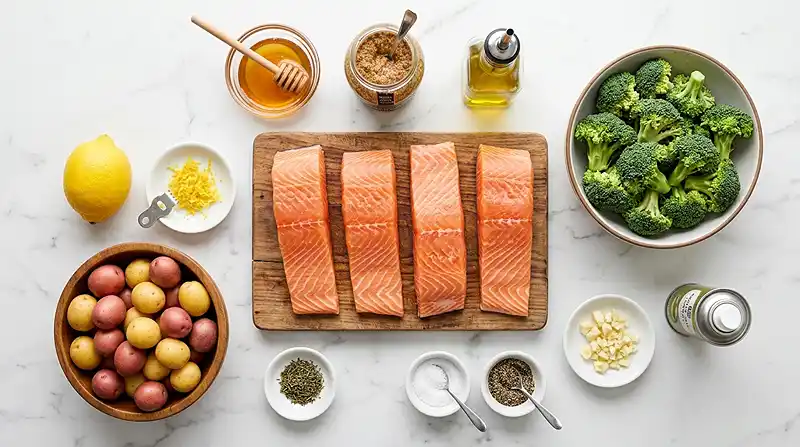
| Ingredient Group | Ingredient | Amount | Notes |
|---|---|---|---|
| Honey Mustard Glaze | Pure honey | 1/4 cup | Pure, not blended |
| Honey Mustard Glaze | Whole grain mustard | 3 tablespoons | Whole grain, not Dijon |
| Honey Mustard Glaze | Olive oil, divided | 1 1/2 tablespoons | Divided use |
| Honey Mustard Glaze | Lemon zest | 1-2 teaspoons (zest of 1 lemon) | Save lemon for wedges |
| Honey Mustard Glaze | Garlic, finely minced | 2 teaspoons (1 large or 2 small cloves) | Finely minced only |
| Honey Mustard Glaze | Dried thyme | 1/2 teaspoon | Dried works great |
| Honey Mustard Glaze | Fine salt | 1/2 teaspoon, more to taste | Taste and adjust |
| Honey Mustard Glaze | Black pepper | 1/4 teaspoon | Freshly ground is best |
| Main Ingredients | Salmon fillets | 4 fillets (4-5 oz each, about 1 inch thick) | Even thickness matters |
| Main Ingredients | Broccoli, cut into florets | 1 large head (4-5 cups) | Similar-sized florets |
| Main Ingredients | Small red or yellow potatoes, halved if large | 1 lb | Small and even-sized |
| Prep | Cooking spray | Generous amount | Prevents sticking |
Whole grain mustard is non-negotiable here — it gives the glaze texture and a slightly milder tang than Dijon, which means it won’t overpower the salmon.
For the potatoes, small red or yellow varieties roast faster and get better color. And if you’re looking for other easy clean eating dinners built around simple pantry ingredients, this one fits that perfectly.
The salmon should be about 1 inch thick and roughly the same size across all four fillets. Uneven thickness means uneven cooking — and that’s how you end up with one perfect piece and one that’s overcooked.
How to Make Honey Mustard Salmon Step by Step
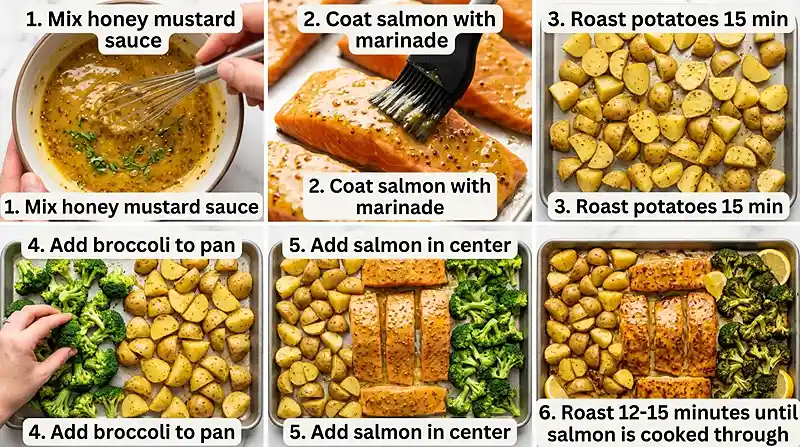
Step 1: Prep the Oven and the Glaze
- Preheat the oven to 400°F.
- In a small bowl, whisk together the honey, whole grain mustard, 1 tablespoon olive oil, lemon zest, minced garlic, dried thyme, salt, and pepper.
- Taste the glaze and adjust salt as needed.
- Set aside 3 tablespoons of the honey mustard mixture in a separate small bowl — this portion is reserved for the potatoes.
Pro Tip: The key to a balanced glaze is tasting before it hits the pan — adjust the salt at this stage and you won’t need to chase seasoning later.
Step 2: Coat the Salmon
- Place the 4 salmon fillets in a shallow bowl.
- Spoon the remaining honey mustard mixture over the salmon.
- Use a spatula or marinade brush to coat the salmon on all sides.
- Set the coated salmon aside while you prep the pan.
Step 3: Start the Potatoes First
- Generously mist a large rimmed baking sheet with cooking spray.
- Place the halved potatoes on the prepared pan.
- Toss the potatoes with the 3 tablespoons reserved honey mustard mixture until well coated.
- Spread the potatoes cut-side down in an even layer across the pan.
- Bake for 15 minutes.
Pro Tip: For best results, place potatoes cut-side down so they develop a golden, caramelized surface — this is what separates properly roasted potatoes from steamed-soft ones.
Step 4: Add the Broccoli and Salmon
- Remove the pan from the oven after 15 minutes.
- Push the potatoes to one side so they take up roughly one-third of the pan.
- Add the broccoli florets to the opposite end of the pan, leaving the middle section open for the salmon.
- Drizzle the broccoli with the remaining 1/2 tablespoon olive oil and toss until evenly coated.
- Sprinkle the broccoli with a pinch of salt.
- Place the glazed salmon fillets on the baking sheet in the space between the potatoes and broccoli.
Step 5: Finish and Serve
- Return the pan to the oven and cook until the salmon flakes easily with a fork, another 8 to 13 minutes depending on thickness.
- Serve immediately with lemon wedges on the side.
Pro Tip: The most common mistake is pulling the salmon too early out of fear of overcooking — use a fork to test for easy flaking at the thickest part before calling it done.
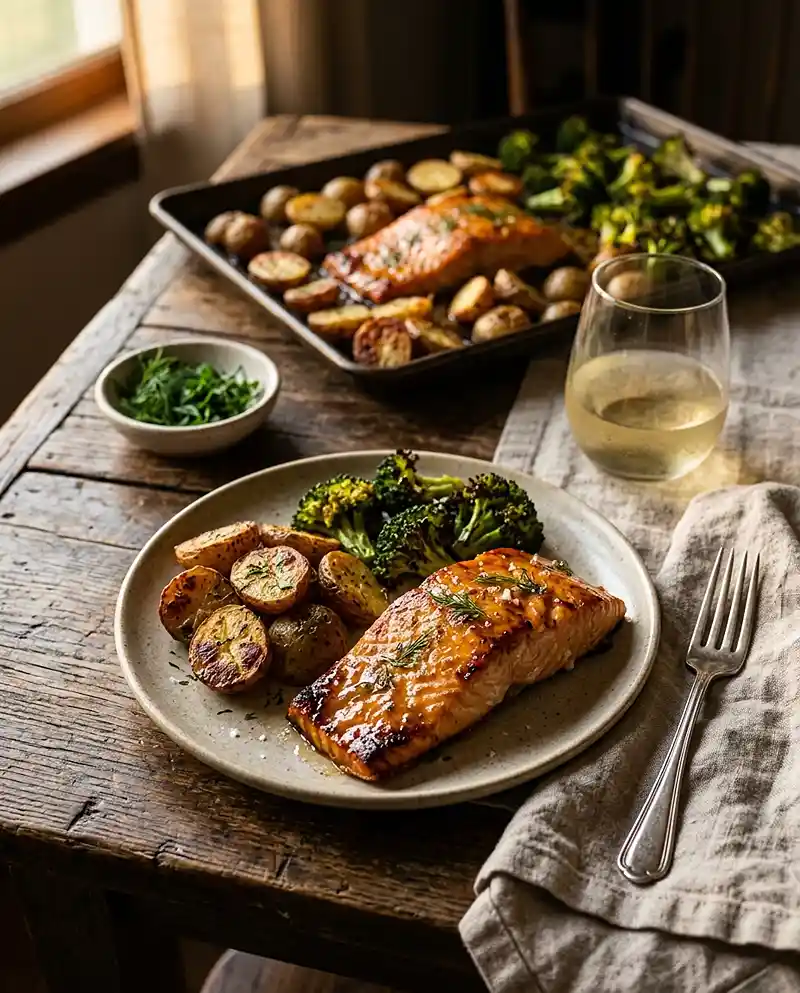
Expert Tips for Perfect Sheet Pan Honey Mustard Salmon
Pro Tips for Success
“The key to caramelized, glossy salmon is a hot oven — don’t be tempted to drop below 400°F.” Lower temperatures steam the fish instead of roasting it, and you lose that beautiful golden exterior on the glaze.
Cut your broccoli florets to a similar size. I learned this the hard way — tiny florets char while the big ones are still raw. Uniform sizing means everything finishes at the same time.
“For best results, let the coated salmon sit at room temperature while the potatoes do their first 15-minute bake.” It takes the chill off the fillets and helps them cook more evenly.
The most common mistake is crowding the pan. If everything is piled on top of itself, it’ll steam and go soggy instead of roasting. Use a large rimmed sheet — at minimum 18×13 inches.
“Sheet pan honey mustard salmon works best when the potatoes are genuinely small or cut to a similar size” — large chunks won’t cook through in the same time as the salmon.
Delicious Variations
Healthy Version: Sub out the potatoes for extra broccoli or add a second vegetable like green beans or asparagus. You’ll get all the protein and flavor with a lighter carb load — one of those easy clean eating dinners that still feels satisfying.
Alternative Glaze: Swap the whole grain mustard for Dijon if that’s what you have on hand. The texture changes (smoother glaze) but the flavor is still great. You can also add a pinch of red pepper flakes to the glaze if you want a little heat.
Dairy-Free / Gluten-Free: This recipe is naturally both dairy-free and gluten-free as written — just double check that your mustard brand doesn’t contain any added gluten. It’s a solid option for a crowd with mixed dietary needs.
Troubleshooting Common Problems
Problem: Salmon is overcooked and dry.
Solution: Start checking at 8 minutes. Thinner fillets (under 1 inch) cook faster. Pull the salmon the moment it flakes easily at the thickest point — carryover heat will finish the rest.
Problem: Potatoes are still undercooked when salmon is done.
Solution: Make sure potatoes are halved or small enough to cook in 15 minutes before the salmon goes in. If they’re still firm when you add the salmon, give them another 5 minutes before adding the fish.
Problem: Broccoli is burnt while salmon is still undercooked.
Solution: Make sure florets are not too small, and that they’re tossed with oil so they don’t dry out. If your oven runs hot, tent the broccoli side loosely with foil for the last few minutes.
How to Store and Reheat Sheet Pan Honey Mustard Salmon
| Storage Method | Duration | Best Practice |
|---|---|---|
| Room Temperature | Up to 2 hours | Don’t leave salmon out longer — food safety matters |
| Refrigerator | Up to 3 days | Store in an airtight container; keep salmon separate from vegetables if possible |
| Freezer | Up to 2 months | Freeze salmon only; vegetables don’t freeze and reheat well |
To reheat, use a 300°F oven for about 10-12 minutes — low and slow keeps the salmon from drying out. You’re looking for it to feel warm through the thickest part without smelling like it’s cooking again.
Leftovers are great for meal prep. Flake the cold salmon over a Greek yogurt ranch pasta salad for a high-protein next-day lunch, or tuck it into lettuce wraps with leftover broccoli.
The potatoes reheat beautifully in a dry skillet over medium heat — 3-4 minutes per side and they’re crispy again. Way better than the microwave.
FAQs About Sheet Pan Honey Mustard Salmon
Can I use frozen salmon for this recipe?
Yes, but thaw it completely first and pat it very dry before applying the glaze. Frozen salmon holds a lot of water — if it’s still wet, the glaze won’t adhere properly and the salmon will steam rather than roast. Thaw overnight in the fridge for best results.
Can I make the honey mustard glaze ahead of time?
You can make the glaze up to 2 days ahead and store it covered in the refrigerator. Give it a good stir before using since the oil can separate. Don’t marinate the salmon for longer than 30 minutes before baking — the acid from the lemon zest will start to break down the texture of the fish.
What can I substitute for broccoli?
Asparagus, green beans, or zucchini all work well and cook in a similar time frame. Cauliflower is a solid swap if you want to keep it in the same vegetable family. Avoid very watery vegetables like zucchini in large amounts — they release moisture and can make the pan steamy instead of roasty.
How do I know when the salmon is done?
The most reliable way: press a fork into the thickest part and twist gently. If it flakes apart in clean layers, it’s done. The flesh should look opaque through the thickest section, not translucent pink in the center. An internal temperature of 125-130°F is medium; 145°F is fully cooked through.
Can I make this recipe for meal prep?
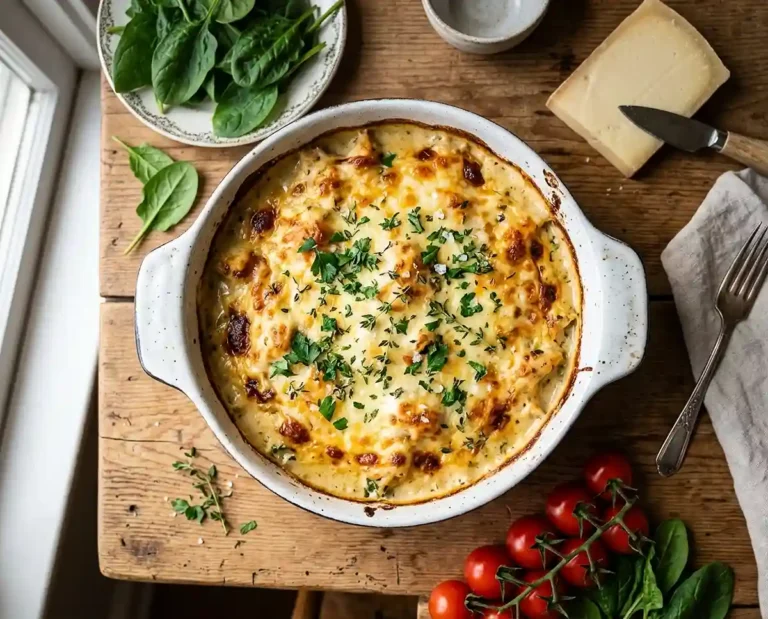
Absolutely — it’s one of the better high protein dinners for weekly meal prep. Cook a full batch, portion into containers with the potatoes and broccoli, and refrigerate for up to 3 days. The salmon is great cold or gently reheated. If you’re meal prepping regularly, recipes like this Boursin spinach chicken bake follow a similar low-prep, one-pan format and round out a full week easily.
Ready to Make It Tonight?
Seriously — this is one of those weeknight healthy meals you’ll come back to again and again. One pan, real ingredients, minimal cleanup, and it honestly tastes like you tried harder than you did.
If you make it, I’d love to hear how it went in the comments below. Did you swap out a vegetable? Add heat to the glaze? Tell me everything.
And save this one to Pinterest — it’s the kind of easy, healthy dinner that’s worth keeping somewhere you’ll actually find it again.
Pin it, make it, and come back to tell me what you thought. I mean it.
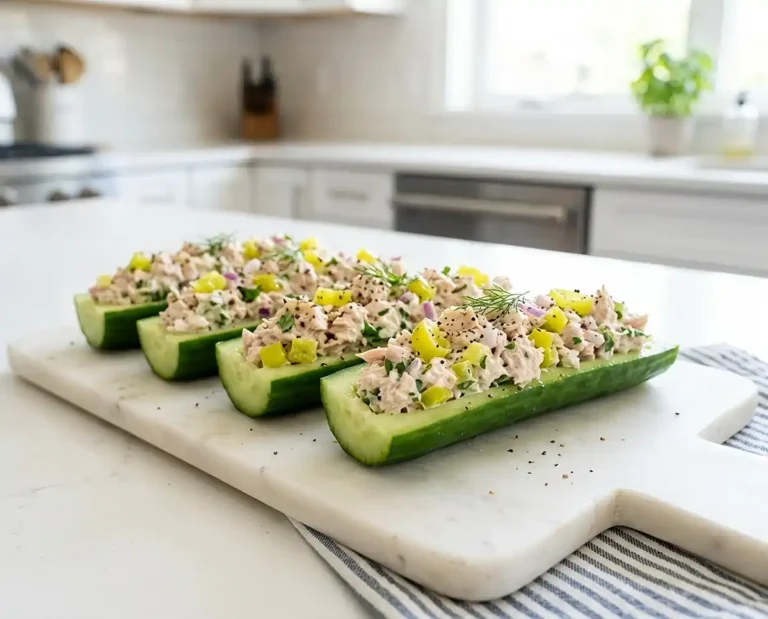
Craving more easy, protein-packed dinners? Try these Mediterranean tuna cucumber boats for a no-cook option that comes together in minutes.
Easy Sheet Pan Honey Mustard Salmon and Veggies — flaky salmon glazed with tangy honey mustard, roasted with broccoli and golden potatoes on one pan. Your new favorite weeknight dinner. Save this recipe now!
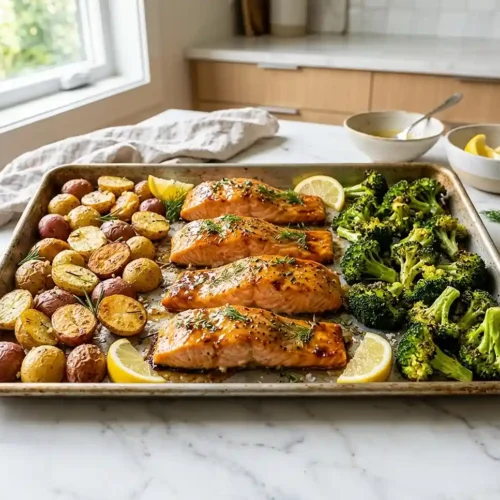
Sheet Pan Honey Mustard Salmon
Equipment
- Large rimmed baking sheet
- Small mixing bowl
- Whisk
- Spatula or marinade brush
- Cooking spray
Ingredients
Honey Mustard Glaze
- ¼ cup pure honey
- 3 tablespoons whole grain mustard
- 1 tablespoon olive oil part of 1½ tbsp divided
- 1-2 teaspoons lemon zest zest of 1 lemon; cut lemon into wedges for serving
- 2 teaspoons garlic, finely minced 1 large or 2 small cloves
- ½ teaspoon dried thyme
- ½ teaspoon fine salt more to taste
- ¼ teaspoon black pepper
Main Ingredients
- 4 salmon fillets about 1 inch thick, 4–5 oz each
- 1 large head broccoli, cut into florets 4–5 cups
- 1 lb small red or yellow potatoes halved if large
Prep
- cooking spray generous amount to coat pan
- ½ tablespoon olive oil remaining from divided amount, for broccoli
Instructions
- Preheat the oven to 400°F.
- In a small bowl, whisk together the honey, whole grain mustard, 1 tablespoon olive oil, lemon zest, minced garlic, dried thyme, salt, and pepper. Taste and adjust salt as needed.
- Set aside 3 tablespoons of the honey mustard mixture in a separate small bowl — this portion is reserved for tossing with the potatoes.
- Place the salmon fillets in a shallow bowl. Spoon the remaining honey mustard mixture over the top and use a spatula or marinade brush to coat the salmon on all sides. Set aside.
- Generously mist a large rimmed baking sheet with cooking spray. Place the potatoes on the prepared baking sheet and toss with the 3 tablespoons reserved honey mustard mixture until well coated.
- Spread the potatoes cut-side down in an even layer on the pan. Bake for 15 minutes.
- Remove the pan from the oven. Push the potatoes to one side so they take up about one-third of the pan.
- Add the broccoli florets to the opposite end of the pan, leaving the middle section open for the salmon.
- Drizzle the broccoli with the remaining ½ tablespoon olive oil and toss until evenly coated. Sprinkle with a pinch of salt.
- Place the glazed salmon fillets on the baking sheet in the space between the potatoes and broccoli.
- Return the pan to the oven and bake until the salmon flakes easily with a fork, another 8 to 13 minutes depending on thickness.
- Serve immediately with lemon wedges on the side.