Quiche Lorraine Recipe
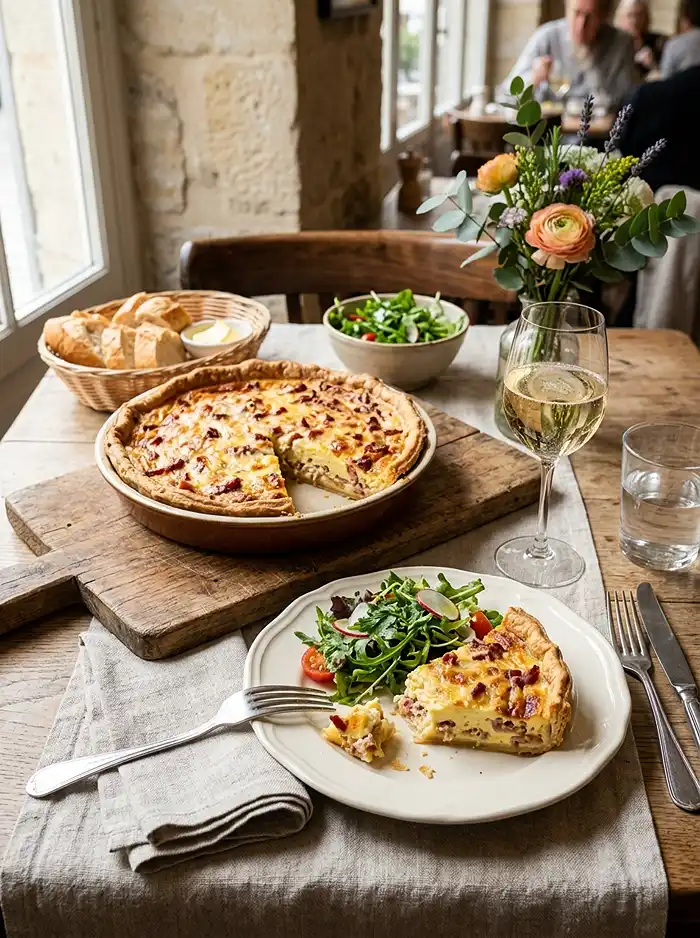
Make this classic quiche lorraine recipe once and you’ll understand why it’s been on French tables for centuries. Smoky bacon, nutty Gruyère, and a silky egg custard baked in a golden crust — it’s the kind of dish that looks impressive but doesn’t ask much of you.
Quiche Lorraine is a savory French custard tart made with bacon, eggs, heavy cream, and Gruyère cheese in a flaky pie crust. This recipe serves 6, delivers a rich, golden custard with crispy bacon throughout, and is perfect for brunch, a light weeknight dinner, or meal prep.
Here’s everything you need to make it perfectly.
I’ve made this quiche lorraine recipe more times than I can count — and the first three times, I got a runny center. Turns out, 325°F is non-negotiable. High heat rushes the custard and it never sets right.
Table of Contents
Why You’ll Love This Quiche Lorraine
This quiche lorraine hits every note: salty, creamy, slightly smoky, with a crust that actually holds its shape when you slice it.
The custard stays tender without being eggy, and the Gruyère melts into every bite rather than clumping on top. It reheats beautifully, which makes it a genuinely useful make-ahead dish.
And because it starts with a frozen deep-dish crust, you’re not spending an hour on pastry. The filling does all the talking.

Classic Quiche Lorraine
Equipment
- 9-inch deep-dish pie crust
- Baking sheet
- Medium nonstick pan
- Medium Mixing Bowl
- Whisk
Ingredients
Crust
- 1 9-inch frozen deep-dish pie crust thaw just until pliable
Main Filling
- 8 oz thick-cut bacon, diced about 6 slices, thick-cut gives best texture
- ½ cup shallots, chopped about 2 medium shallots, don’t brown them
Custard
- 4 large eggs room temperature preferred
- 1 ¼ cups heavy cream full-fat only
Seasoning
- ¼ teaspoon salt
- ⅛ teaspoon cayenne pepper adds warmth, not heat
- 1 pinch ground nutmeg classic French custard note
Cheese
- 4 oz Gruyère cheese, finely shredded about 1 1/4 cups, finely shredded melts best
Instructions
- Preheat the oven to 400°F (200°C) and place a rack in the middle position.
- Thaw the frozen pie crust for about 10 minutes until soft enough to prick with a fork.
- Prick the bottom and sides of the crust all over with a fork to prevent puffing.
- Place the crust on a baking sheet and bake for 10 to 15 minutes until lightly golden. If the crust puffs, prick it again gently with a fork.
- Remove the crust from the oven and reduce the oven temperature to 325°F (170°C).
- In a medium nonstick pan over medium heat, cook the diced bacon until crisp, about 10 minutes. Transfer to a paper towel-lined plate using a slotted spoon.
- Pour off all but 1 tablespoon of bacon fat from the pan.
- Add the chopped shallots and cook over medium-low heat for 3 to 4 minutes until soft and translucent. Do not brown them.
- In a medium bowl, whisk the eggs until smooth. Add the heavy cream, salt, cayenne pepper, and nutmeg, whisking until fully combined.
- Spread the cooked shallots evenly over the bottom of the blind-baked crust.
- Scatter half of the crispy bacon over the shallots.
- Add the shredded Gruyère cheese in an even layer, then top with the remaining bacon.
- Slowly pour the custard mixture over the filling.
- Bake the quiche at 325°F (170°C) for 45 to 50 minutes until the custard is set and lightly golden on top. The center should have a slight jiggle.
- Serve hot or warm.
Notes
What Ingredients Do You Need for Quiche Lorraine?
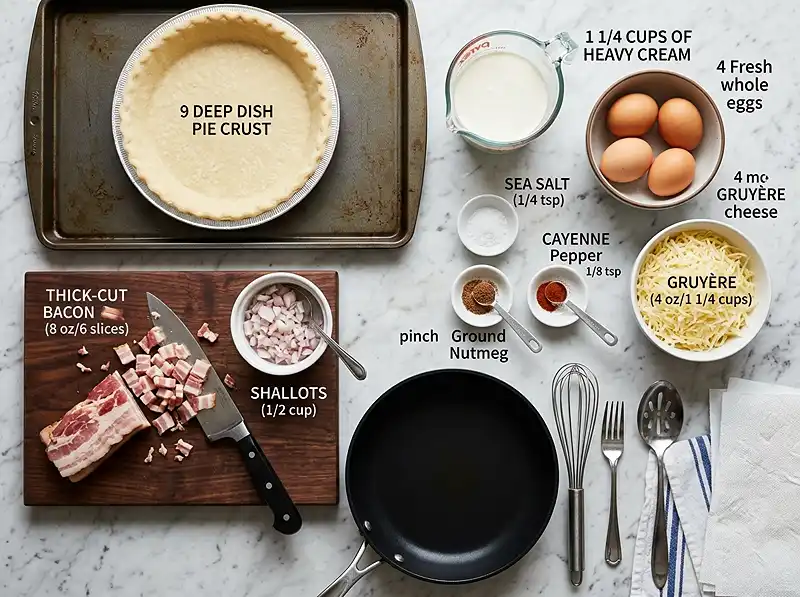
| Ingredient Group | Ingredient | Amount | Notes |
|---|---|---|---|
| Crust | Frozen deep-dish pie crust | One 9-inch (23-cm) | Thaw just until pliable |
| Main Filling | Thick-cut bacon, diced | 8 oz (about 6 slices) | Thick-cut gives best texture |
| Main Filling | Shallots, chopped | ½ cup (2 medium shallots) | Don’t brown them |
| Custard | Large eggs | 4 | Room temp preferred |
| Custard | Heavy cream | 1¼ cups | Full-fat only |
| Seasoning | Salt | ¼ teaspoon | — |
| Seasoning | Cayenne pepper | ⅛ teaspoon | Adds warmth, not heat |
| Seasoning | Ground nutmeg | Pinch | Classic French custard note |
| Cheese | Gruyère, finely shredded | 4 oz (about 1¼ cups) | Finely shredded melts best |
Gruyère is the soul of a proper quiche lorraine — its nutty, slightly sweet flavor is what separates this from a generic egg tart. Don’t swap it for Swiss or mozzarella.
Heavy cream is also non-negotiable here. Half-and-half makes the custard looser and less rich. The thick-cut bacon matters too — thin strips get lost in the custard rather than giving you those satisfying bites of smoky meat.
How to Make Quiche Lorraine Step by Step

Blind Bake the Crust
- Preheat your oven to 400°F (200°C) and set a rack in the middle position.
- Remove the frozen pie crust and thaw for about 10 minutes, just until soft enough to prick with a fork.
- Prick the bottom and sides all over with a fork to prevent puffing.
- Place the crust on a baking sheet — this makes it easy to move in and out of the oven safely.
- Bake until lightly golden, 10 to 15 minutes. If it puffs up, gently prick it again with a fork so it deflates.
- Remove from the oven and reduce the temperature to 325°F (170°C). Set the crust aside.
Pro Tip: The key to a non-soggy quiche lorraine is blind baking the crust before adding any filling. Skip this step and you’ll end up with a pale, doughy bottom that never crisps up.
Cook the Bacon and Shallots
- In a medium nonstick pan over medium heat, cook the diced bacon, stirring occasionally, until crisp, about 10 minutes.
- Use a slotted spoon to transfer the bacon to a paper towel-lined plate to drain.
- Pour off all but one tablespoon of fat from the pan.
- Add the chopped shallots and cook over medium-low heat until soft and translucent, 3 to 4 minutes. Do not let them brown.
- Remove the pan from the heat and set aside.
Pro Tip: For best results, keep the shallots over medium-low heat and stir them gently. Browning changes their flavor from sweet and delicate to sharp, which throws off the balance of the custard.
Make the Custard
- In a medium bowl, whisk the 4 large eggs until smooth.
- Add the heavy cream, salt, cayenne pepper, and nutmeg. Whisk until everything is evenly combined.
Assemble and Bake
- Spread the cooked shallots evenly over the bottom of the blind-baked crust.
- Scatter half of the crispy bacon over the shallots.
- Add all of the shredded Gruyère in an even layer.
- Top with the remaining bacon.
- Slowly pour the egg and cream custard mixture over the top.
- Slide the quiche (still on the baking sheet) into the 325°F oven and bake for 45 to 50 minutes, until the custard is set and lightly golden on top.
- Serve hot or warm.
Pro Tip: The most common mistake is pulling the quiche too early. The center should have just a slight jiggle — like set Jell-O, not liquid. If it sloshes, give it another 5 minutes.
Expert Tips for Perfect Quiche Lorraine
Pro Tips for Success
“The key to a silky custard is low-and-slow baking at 325°F. Higher heat causes the eggs to scramble inside the tart, leaving you with a grainy, rubbery texture instead of the creamy, tender set you’re after.”
Finely shredding the Gruyère makes a real difference. Coarsely grated cheese tends to clump and doesn’t distribute evenly through the custard. A fine shred melts seamlessly into every slice.
“The most common mistake is overcrowding the pan with bacon — instead, layer half the bacon, then the cheese, then the rest of the bacon. This way every bite gets both, and the top layer crisps slightly in the oven.”
If your crust cracks during blind baking, don’t panic. Press a small piece of the raw dough into the crack, then brush with a bit of egg wash to seal it before the filling goes in. Real talk — this happens to everyone at least once.
“Quiche Lorraine works best when the custard is poured in slowly and evenly. Dumping it in fast can displace the fillings you just arranged, so take your time.”
Delicious Variations
Make it dairy-free: Swap heavy cream for full-fat coconut cream and use a dairy-free shredded cheese. The custard won’t be quite as rich, but it sets well and the bacon flavor still carries everything.
Go crustless: Skip the pie crust entirely and bake the filling in a well-greased 9-inch pie dish. You get a lighter, lower-carb quiche lorraine that actually works really well for meal prep since it slices cleanly.
Add herbs: A tablespoon of fresh thyme or chives whisked into the custard gives the quiche a fresher, more spring-like flavor. It pairs especially well if you’re serving this for a weekend brunch.
Troubleshooting Common Problems
Problem: Custard is watery or runny after baking.
Solution: The oven was likely too hot or the quiche was underbaked. Always use 325°F and check for that slight center jiggle before pulling it out. A fully liquid center needs more time, full stop.
Problem: The crust is soggy on the bottom.
Solution: Blind baking is the fix — and it only works if the crust is properly pricked all over first. Make sure there are no gaps in the fork pricks along the sides.
Problem: The top is golden but the center is still soft.
Solution: Tent the quiche loosely with foil and continue baking. The foil stops more browning while letting the interior catch up over the next 5 to 10 minutes.
How to Store and Reheat Quiche Lorraine
| Storage Method | Duration | Best Practice |
|---|---|---|
| Room Temperature | Up to 2 hours | Cover loosely; don’t leave out longer |
| Refrigerator | Up to 4 days | Wrap tightly in plastic or store in airtight container |
| Freezer | Up to 3 months | Freeze fully cooled slices individually on a tray first |
To reheat, place a slice in a 325°F oven for 12 to 15 minutes until warmed through and the crust crisps back up. The microwave works in a pinch but makes the crust soft — and honestly, soft crust is a tragedy for something this good.
Leftover quiche lorraine makes a genuinely great next-day lunch straight from the fridge. Cold quiche has a firmer, almost terrine-like texture that’s different but still delicious. Serve it with a simple avocado corn black bean salad for a meal that comes together in minutes.
FAQs About Quiche Lorraine Recipe
Can I make quiche lorraine ahead of time?
Yes. Quiche Lorraine can be baked a full day ahead, cooled completely, then wrapped and refrigerated. Reheat in a 325°F oven for 15 to 20 minutes before serving.
You can also prep the components separately — cook the bacon and shallots, mix the custard — then assemble and bake the next morning. This cuts active prep time to under 10 minutes on the day.
What’s the difference between quiche lorraine and regular quiche?
Classic quiche lorraine contains only bacon (lardons), eggs, cream, and Gruyère — no vegetables, no herbs beyond nutmeg, no other add-ins. It comes from the Lorraine region of France and is the original version of quiche.
Most “quiches” people make today are variations on this base — adding spinach, mushrooms, or different cheeses. Delicious, but technically a different dish.
Can I use milk instead of heavy cream?
Whole milk produces a much thinner, less rich custard that may not set as firmly. If you must substitute, use a mix of ¾ cup whole milk and ½ cup heavy cream rather than swapping entirely.
Half-and-half is a better middle-ground option. Avoid low-fat milk — the custard tends to weep liquid after baking and the texture turns rubbery.
How do I know when my quiche lorraine is done baking?
The custard should be set around the edges but have a slight jiggle in the very center — similar to a just-set cheesecake. It will firm up further as it cools on the counter.
If the center looks liquid and moves freely when you shift the pan, it needs more time. A knife inserted 1 inch from the center that comes out clean is a reliable doneness cue.
Can I freeze quiche lorraine?
Yes. Cool completely, then freeze individual slices on a baking sheet before transferring to a freezer bag. This prevents them from sticking together.
To reheat from frozen, place slices on a baking sheet in a 325°F oven for 25 to 30 minutes. Thawing overnight in the fridge first cuts reheating time to about 15 minutes. The crust may soften slightly, but the custard holds up well.
Ready to Make This?
Honestly, this quiche lorraine is one of those recipes that earns its place in your regular rotation fast. It’s the kind of thing you make for brunch guests and they assume you’ve been cooking French food for years.
If you love egg-based dishes, you’ll also want to try this eggs benedict recipe with hollandaise sauce — it’s another weekend morning showstopper. And if you need something to drink alongside, this ginger pineapple tea is seriously refreshing.
Save this to your Pinterest boards so it’s easy to find when brunch season hits. And if you make it, drop a comment — I mean it, I love hearing how it turns out for people.
Classic quiche lorraine recipe with crispy bacon, nutty Gruyere, and a silky egg custard in a golden crust. Rich, satisfying, and easier than it looks. Save this for your next brunch!